
How to grow Twitter followers by reaching people who don't follow you yet
How do you grow Twitter followers? Stick to one subject, post formats strangers stop for, reply in your niche, and avoid spammy habits.

Every follower you gain on X starts as a stranger, and X is stricter about what it recommends to strangers than about what it shows your followers.
Miss that, and your posts keep reaching the people who already follow you while the count stops moving.
Short answer: grow Twitter followers by posting about one clear subject in formats people stop for, replying where your future followers already talk, and keeping a steady schedule. The catch: every new follower comes from people who don't follow you yet, and X ranks your posts lower for them than for your followers and stops recommending accounts that look spammy.
The rest covers each move, what X's ranking measures when a stranger sees a post, and what takes an account out of recommendations.
How to grow Twitter followers among people who don't know you yet
Four moves do most of the work to grow Twitter followers on a new or stalled account. Each one is aimed at the stranger scrolling past, because the people who already follow you can find your posts in their Following tab.
Give strangers one subject to remember you by
A stranger who likes one of your posts decides whether to follow by guessing what comes next.
Make the guess easy.
Post mostly about one subject and a close neighbor or two, and say so in your bio. X's Get your business started with X page describes the bio as the place to share "what you do, your value, and why to follow."
A steady subject also helps X place you. The systems that find posts for people who don't follow you match each post against what those people already engage with, so an account that stays on one subject keeps landing in front of the same kind of reader. That repeated exposure is how you grow your Twitter followers past your first circle.
X sometimes explains a recommendation, too, by adding the name of the Topic or by naming who in the reader's network follows or reposted the author. Each respected account in your niche that follows you is context a stranger may see next to your post.
Write for the first line and the full read
X's ranking model predicts dwell and dwell time for every post, and it counts "not dwelled," a reader scrolling straight past, against the post.
A stranger meets your post in For You, mixed in with posts from accounts they chose to follow, so the first line decides whether they stop.

Lead with the claim, the number or the result, and put the setup after it; a first line that only warms up gives a stranger nothing to stop for.
My own test for an opener: if it could start anyone's post, I rewrite it.
Then pick the format that holds the rest of the idea. Three formats give a stranger more reason to stay:
- Threads, for ideas with steps or parts. Add each post with the plus icon and select Post all; from four posts on, timelines cut the thread short behind Show this thread, so the opener has to stand alone.
- Images and native video, for anything visual. A post holds up to 4 photos, a GIF or a video, and photo expands and video opens are actions the model predicts too.
- Longer posts, if you subscribe to X Premium, for one idea that needs up to 25,000 characters.
Reply inside the conversations strangers chose to open
Replies reach strangers through a different door: the reader is already inside a conversation they chose to open.
When X ranks replies, it considers:
- Whether the original author replied.
- Whether the reply comes from someone the reader follows.
- Whether the replier subscribes to X Premium.
Write replies an author would want to answer: a precise question, a number from your own work, a counterexample.
Quote posts work the other way around. They put your comment on your own profile and in front of your followers, with the original post attached for context, so save them for takes that deserve their own spot.
When a stranger from those conversations keeps replying to you, consider following back. Since July 2026, X has rolled out a boost for many users that adds weight to the predicted chance they reply to an original post from someone they follow mutually.
So a mutual follow keeps your next posts in front of the readers already talking to you, and keeping those new followers engaged is part of growing Twitter followers too.
Post on a steady schedule
X's own growth advice for businesses is to post consistently, because sharing frequently gives people a reason to follow you.
On x.com, the calendar icon at the bottom of the compose box schedules a post for any date and time you pick, and scheduled posts wait under Unsent posts, which keeps the account active on busy days. Longer posts are the exception; X says they can't be scheduled yet.
Each move answers a question a stranger asks without saying it:
- What is this account about?
- Is this post worth my time?
- Have I seen this person somewhere useful?
- Will there be more tomorrow?
What X's ranking measures when a stranger sees your post
For every candidate post, X's ranking model predicts how likely the viewer is to take each of about two dozen actions, then adds the predictions into one score, with positive weights for good actions and negative weights for bad ones.
X's open-source For You repository groups the actions this way:
- Engagement: like, reply, repost, quote and share.
- Clicks: opening the post, your profile, a link, a photo or a video.
- Attention: dwell, dwell time and video quality views.
- Author: following the author.
- Negative: "not interested," mute, block, report and "not dwelled."
Two details change how to read that list. The weights multiply the viewer's own predicted probability of each action, not raw counts, and X's notes on the code warn that a large report weight doesn't mean one report cancels out 468 likes.
Posts from accounts the viewer doesn't follow are also multiplied by a factor below 1, so a post has to earn more predicted interest to reach a stranger than to reach a follower.
Twitter follower growth comes from the posts that clear that discount: the ones a stranger stops for, reads to the end and follows from.
The same pipeline in X's 2023 diagram
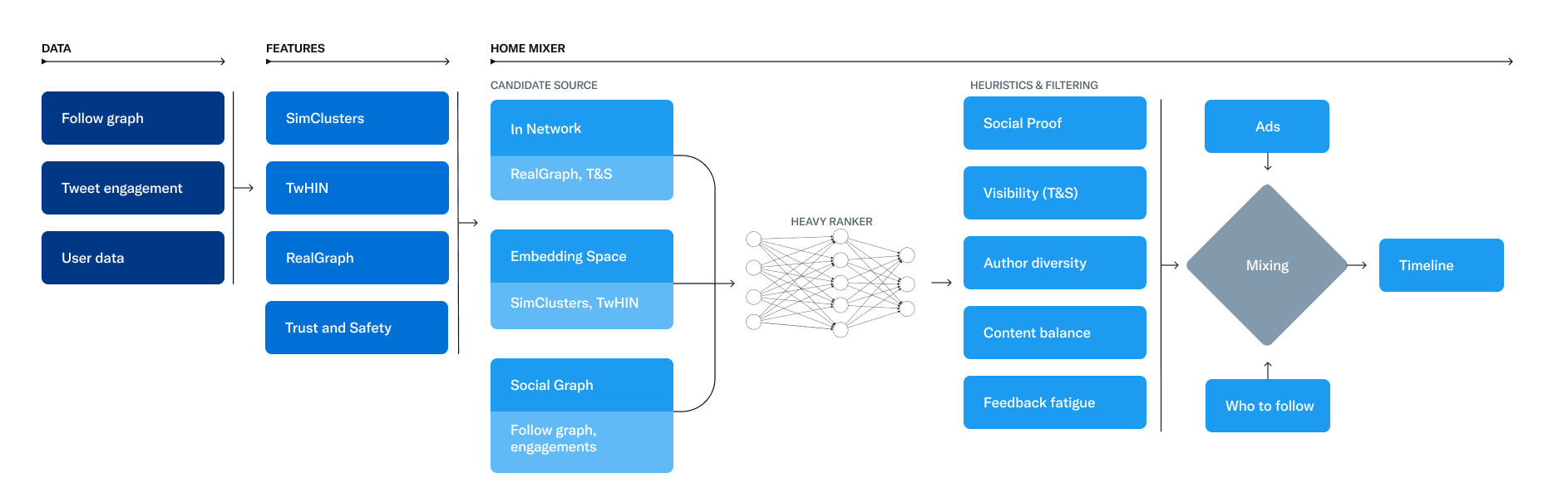
X's engineering blog drew the 2023 version of this pipeline: candidate sources feed a heavy ranker, then filters such as author diversity and feedback fatigue run before the timeline is mixed with ads and Who to follow. The 2026 code keeps that shape, with a transformer model doing the ranking.
Why would X stop recommending your account?
X keeps an account out of recommendations when its recommendation policy puts it in one of three groups:
- Accounts that recently violated the X Rules.
- Accounts thought to be engaged in spammy behavior.
- Accounts with graphic violence or hateful imagery in their profile.
Their posts don't disappear. X says content that can't be recommended stays available to people who follow the author and on the author's profile.
That is how an account can keep its followers, keep collecting their likes, and still stop gaining new ones.
The open-source code shows two ways an account gets there. One system labels accounts from how people respond to their posts, weighing blocks, reports and spam reports against likes. And some visibility rules drop a post only when it would be recommended to someone who doesn't follow the author, while the same post still reaches followers.
That makes two habits costly when you want to grow followers on X. The first is replies that draw blocks and reports. The second is follow churn, which X's follow rules describe as following and then unfollowing large numbers of accounts to inflate your own follower count.
X is also piloting a report called Under the Hood that shows the visibility-limiting labels applied to your account and posts over the prior month, and says it will widen access over time.
Is there a best time to post on X?
X doesn't publish one, and its business advice stops at posting consistently.
What X's open-source code does set is a window: For You drops posts older than 48 hours, so a post has about two days to find its readers.
Time zones matter more than any global chart. If most of your readers live eight hours away from you, a post sent at your lunchtime lands in their night and spends a good part of its window before they wake up.
Spacing matters as well. Each extra post from you in the same viewer's feed is discounted, so two posts an hour apart mostly compete with each other, while the same two posts on different days each get a full window.
To find your own best hours, use a number X already shows. Every post carries a view count that anyone can see, counted wherever the post is viewed.
Post similar content at two or three different times over a few weeks, then compare what each slot collects in its first two days.
Timing alone won't grow followers on X, but it decides how much of that window your readers are awake for.
Write every post for the reader who doesn't follow you
Followers can find your posts in their Following tab either way; strangers see only what X is willing to recommend to them.
So write every post for the stranger, because that is the only reader who can become a new follower.
Growing Twitter followers starts with the next one: one subject, a first line that works alone, and nothing a reader would want to mute.
Questions about reaching new people on X
Where does X list the topics your account is known for?
On x.com, open Interests from X in Your X data and select the Known For tab. X's Topics help page sends you there to stop your account from being featured in a Topic, so the list shows which Topics X links to you.
Do threads reach more people than single posts?
X doesn't say they do. A thread is a series of connected posts, and timelines cut threads of four or more posts short behind Show this thread, so most strangers judge one by its opener.
A thread earns reach the way any post does: people stop, read and engage.
Can you see what your followers are interested in on X?
Only one profile at a time. Topics people follow are public, so you can open a follower's profile, select the more icon and choose View Topics. X's Topics help page describes that per-profile view but no summary across all of your followers.
Should you delete old posts that got no reach?
X doesn't say that deleting weak posts helps an account grow. For You stops considering any post after 48 hours, so a quiet post from last month isn't competing with your next one.
Delete a post when it's wrong or so far off your subject that it would confuse someone checking your profile, not because it flopped.